Unit 7 was the one that was supposed to be easy. Same building as unit four, nearly identical floor plan, same management company. We furnished it the same way we had four and five — same sofa color, same rug, same bed setup. By month two it was averaging a 14% save rate on the platform while our other units were averaging 34%. Same price point, same amenities, same neighborhood. We couldn't figure it out.
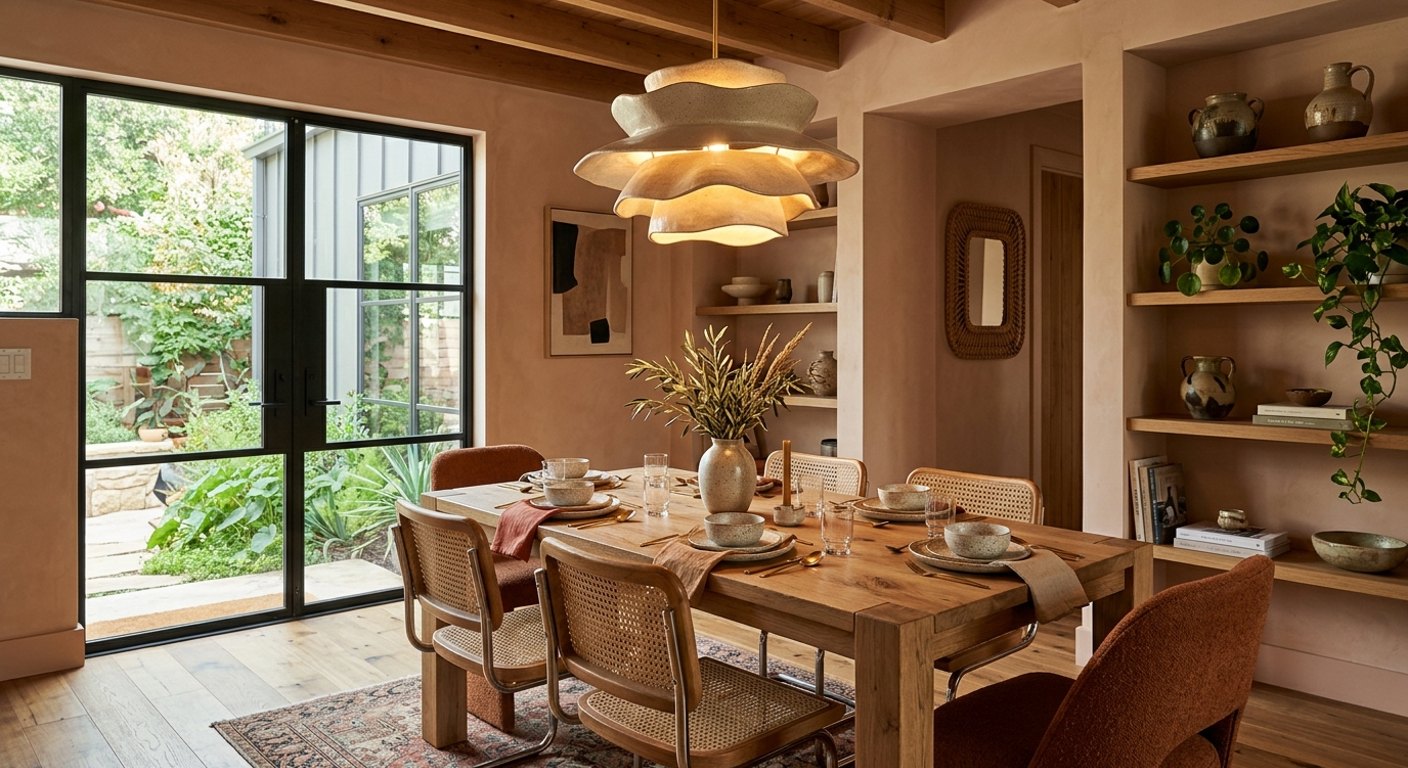
Then we looked at the listing photos side by side. Unit four had a wide-mouthed rattan pendant we'd installed as an afterthought over the dining table. Unit seven had the standard builder ceiling fixture — a brushed-nickel flush-mount that came with the apartment. We'd never replaced it. In the photo, unit four's dining zone had a focal point, something the eye went to and rested on. Unit seven's dining area looked like every other apartment in Austin.
We installed a $260 glass pendant over the dining table in unit seven. Shot it again. Within six weeks the save rate was 37%. The rest of the unit was unchanged.
That was the moment we started thinking seriously about vacation rental interior design not as furnishing — not as filling rooms with appropriate furniture — but as the deliberate creation of one focal moment that makes a listing distinctive in a search results grid. Here's everything we've learned since.
What Vacation Rental Interior Design Actually Is
Most hosts think of interior design as choosing furniture and colors. That's decorating. Vacation rental interior design is something slightly different: it's the art of making a space photograph memorably while simultaneously being durable, easy to clean, and comfortable for guests who range from light packers to families who cook every meal.
The difference matters because the constraints are unlike a permanent home. A beautiful piece of fabric art might look incredible against a bedroom wall — and get destroyed by a guest who leans a wet umbrella against it. A sculptural side table might be gorgeous — and be the thing that every guest clips walking to the bathroom at 2am. Vacation rental design has to solve for the photo and the stay simultaneously, and the stakes are asymmetric: get the photo wrong and you don't get bookings, get the stay wrong and your reviews crater.
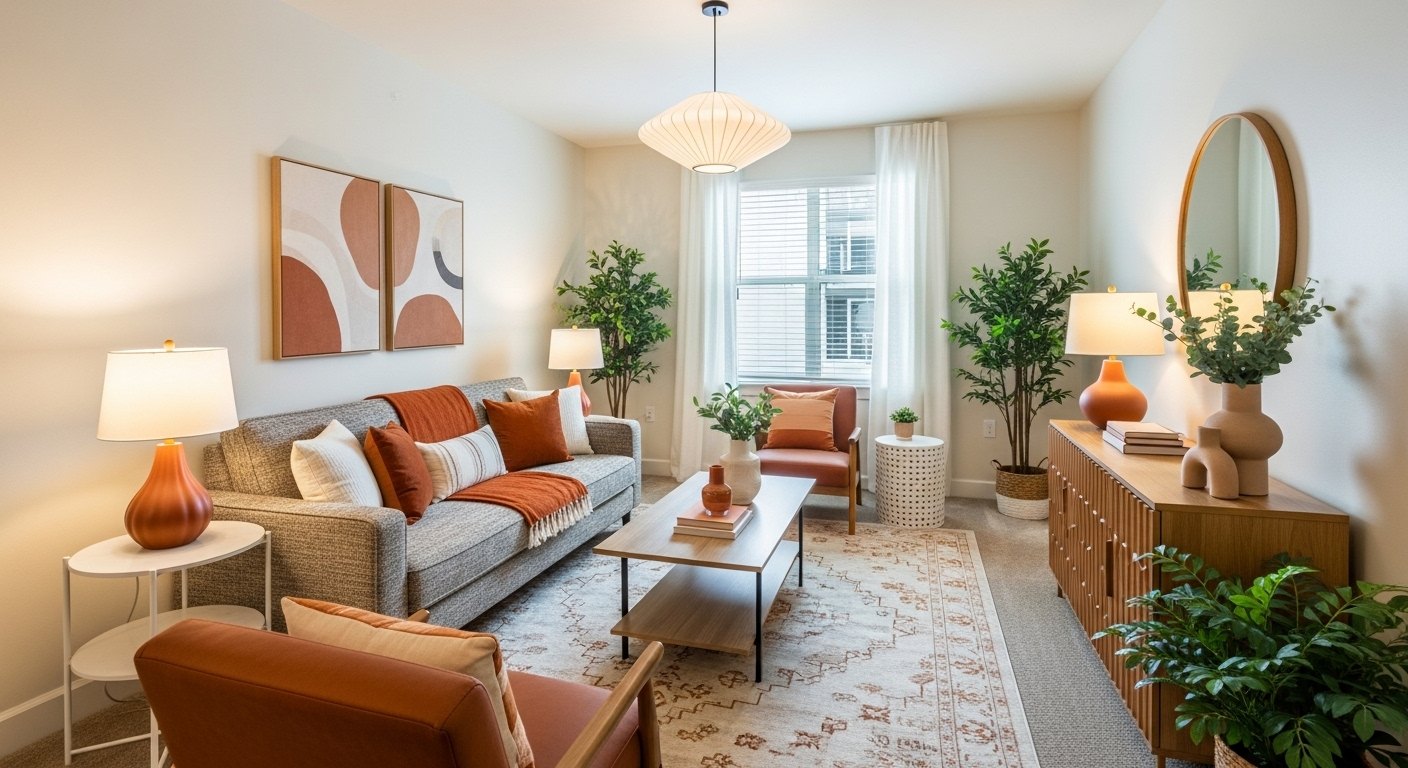
The one principle that we've seen hold across all 12 of our Austin units is this: one focal point, executed well, outperforms sophisticated design everywhere else. Guests scrolling a listing grid don't see rooms, they see frames. And a frame with a clear, distinctive focal point earns a save; a frame where the eye wanders doesn't.
Why Lighting Is the Most Reliable Focal Point
A focal point in vacation rental design can be many things: a piece of art, a distinctive piece of furniture, an architectural feature. But lighting is the most reliable vehicle for it, and here's why.
A light fixture is visible at full scale in a photo taken from across a room. A pendant over a dining table is in the frame whenever anyone photographs the dining zone, which is the most photographed zone in a listing after the bedroom. It can't be moved out of frame the way furniture can. And it creates actual light in the space, which changes how everything around it photographs — not just as an object in the room but as a source of warmth that makes the rest of the image inviting.
Art is the second-best vehicle, but art requires a clear backdrop, consistent lighting, and tends to read as personal in a way that doesn't translate universally across guest demographics. A distinctive pendant light reads as designed to almost everyone. A piece of art reads as someone's taste, which is divisive.
Furniture can be a focal point — a distinctive armchair, a sculptural console — but furniture reads as a smaller detail at the scale of a listing photo. A pendant over a dining table can be visible and striking in a wide-angle shot that shows the whole open-plan. A distinctive chair is a detail that only registers in a close-up or after the guest has already decided to look closely.
Where to Put the Focal Piece
The dining zone is the most reliable placement and the one we default to. Here's why: the dining area in an open-plan apartment or house is almost always in the hero photo of the living space. A wide-angle shot that shows the kitchen, dining area, and living zone in one frame is the standard listing image for that kind of space. Whatever is over the dining table is in that hero shot. It has to earn its position.
Over a four-person dining table, we size the pendant at 18–24 inches in diameter, hung so the bottom of the fixture is 30–36 inches above the table surface. At that size and drop, the fixture is clearly visible from across the room without dominating the space. We've gone larger on two units — 30-inch diameter pendants — in rooms with higher ceilings, and the scale worked. We've gone smaller — 14 inches — and the fixture disappeared in the listing photo. Size up, not down.
The living zone is the second placement. A distinctive fixture over a sofa seating area, or a statement floor lamp beside a reading chair, works well if the living zone carries the listing's main photo. For studios where the sofa is the hero, this can outperform a dining pendant.
Bedrooms are less effective because they're documented in separate photos, the wide-angle tends to be from the foot of the bed, and the focal point of a bedroom photo is usually the bedhead styling. A statement bedside sconce is worth doing but it's supplementary, not the primary focal moment.
The Backdrop Is Half the Work
A focal point only reads as one if the surrounding space is calm enough to let it stand out. The unit seven pendant wouldn't have worked if we'd installed it in a cluttered dining zone with a busy backsplash and six different wood tones competing for attention. It worked because the rest of the unit was restrained — warm greige walls, a simple dining table, chairs in a single neutral, no competing decorative objects on the dining surface.
For every unit where we install a focal pendant or fixture, we do a "background audit" of the zone it goes into. We ask: what else is in the frame in a wide-angle shot? Is there anything else competing for attention? Is the wall behind the fixture clean and unbroken, or is there art, shelving, or a window treatment that creates visual noise? The goal is for the fixture to be the most interesting thing in the frame. Everything around it should be warm, functional, and quiet.
This is counterintuitive for people who think more design means better design. In vacation rental interior design, restraint in the background multiplies the impact of the focal point. One great fixture in a calm room photographs better than three interesting things in a busy one.
The Swag Trick: Statement Without Rewiring
Unit seven's pendant is a swag installation. There was no ceiling box over the dining table — there's a ceiling box in the center of the room, about four feet away from where we wanted the fixture to hang. We installed a ceiling hook rated for 15 pounds at the right location, hung the pendant from the hook, and ran the cord from the hook to the wall inside a paintable cord cover, then down the wall to a duplex outlet behind the credenza.
The whole installation took 40 minutes. The ceiling hook requires one small hole. The cord cover is painted to match the wall. In the listing photos and in person, the pendant looks like it was always there. Guests have not mentioned the cord in any review across 14 months of bookings.
This is the standard installation for any pendant we add to a unit without a ceiling box in the right location. It costs $260 for the fixture, $12 for the hook, $18 for the cord cover and paint. We've done six swag installations across the portfolio. All of them look intentional. None required a permit, an electrician, or landlord approval beyond a conversation.
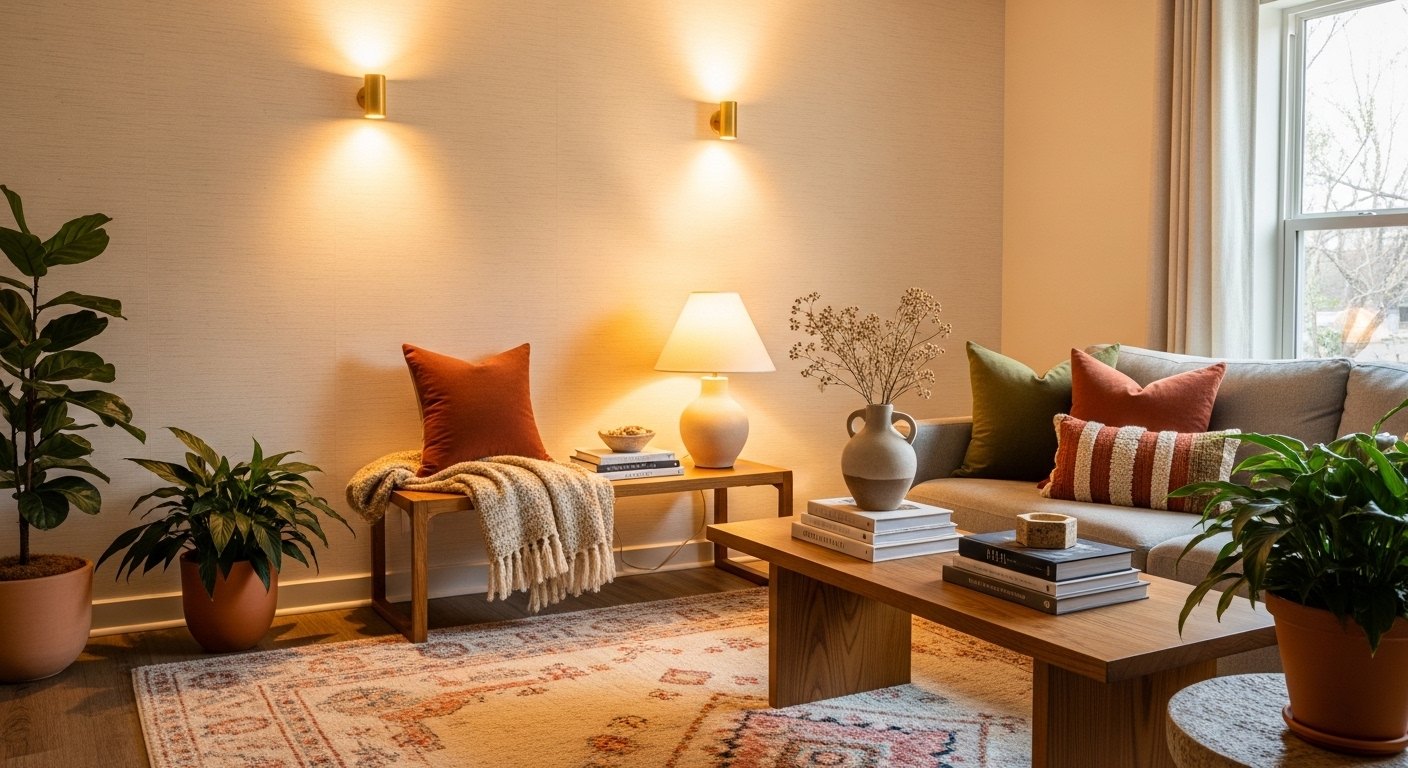
For the living zone, the same principle applies: a glass pendant on a swag hook over a reading chair, or a pair of plug-in wall sconces flanking the sofa, can create a focal moment without touching the existing electrical. The only limit is the cord run — keep the cord cover path clean and paint it out.
What the Fixture Should Look Like
In a short-term rental, the statement fixture should be timeless rather than trend-specific, because it has to work for two to three years of bookings without looking dated. A rattan pendant that looks current in 2026 may look like a trend piece by 2028. A simple glass globe, a clean sculptural form in matte black or brass, a cluster of small pendants — these read as designed across a wider time range.
We also avoid fixtures that require specialty bulbs. A statement pendant that takes E12 candelabra bulbs that a guest can't replace at a convenience store at 10pm is a maintenance problem. Every fixture gets a standard E26 base, a 2700K warm LED, and a spare bulb in the drawer underneath it. Guests who need to change a bulb can. Cleaners who need to can. Nobody has to wait on a delivery.
Dimmable is ideal but not required at the fixture level — we achieve dimming in most units through a smart outlet plug or a smart bulb, rather than hardwired dimmer switches. This gives us scheduling capability (the dining pendant can ramp down at 11pm automatically) and gives guests touchless control via a voice assistant if we have one set up. But even a non-dimmable fixture is worth installing. The save-rate impact doesn't depend on the dimmer.
What Changed After Unit 7
After the unit seven result, we went back to units one through six and audited each one for a primary focal point in the hero photo. Three of them had adequate focal moments (unit four's rattan pendant, unit two's art wall, unit six's architectural arched window). Three didn't. We installed a pendant or statement floor lamp in each of the three that were missing one. Two of the three saw a save-rate increase of 8–12 percentage points within two months. The third is in a building with a restriction on ceiling hooks, so we put in a statement floor lamp beside the sofa and saw a smaller but still positive improvement.
We now budget for a focal fixture in every new unit as a non-negotiable line item, at the same priority level as the mattress and the performance-fabric sofa. The mattress drives reviews. The sofa drives comfort and durability. The focal fixture drives saves, which drive bookings, which is where the revenue actually starts.
Vacation rental interior design isn't about making beautiful spaces. It's about making one thing in the frame so right that someone scrolling past stops and saves it. That's the job of the $260 fixture. And in our portfolio, nothing else has done it as reliably.
Shop this post: modern pendant lighting and glass pendant lights