Furnishing an Airbnb from scratch costs us between $2,800 and $3,400 for a one-bedroom in Austin, takes one long weekend, and follows the same order every time: bed, lighting, sofa, kitchen, bathroom, then whatever is left. It didn't start that way. Our first unit cost $6,400 and three weekends. We bought too many decorative things, forgot half the practical ones, made four return trips to IKEA, and nearly missed the launch date because we underestimated how long it takes to hang curtains when you also have 200 other things to do. By unit four we had a list. By unit seven the list ran itself.
This is that list, room by room, with what each room costs us now and the two or three things in each that guests actually mention in reviews. If you want the shorter tick-box version to print and carry, that's our setup checklist; this post is the reasoning and the budget behind it.
Research Your Comp Set Before You Buy Anything
Before you spend a dollar furnishing, pull up your comp set on the platform. Search your exact area and price range and study the top ten listings by review count. Screenshot their hero photos. Look at what's in the frame: the sofa color, the rug pattern, the light fixture over the dining table, the way the bed is staged. You're not copying, you're calibrating what the market expects and identifying the one or two details that make the best listings stand out.
On unit three we skipped this step and bought a sofa we thought looked great. It photographed terribly against our wall color. We sold it for $180 and bought a better-toned piece off Facebook Marketplace for $340. An hour of research before any purchase would have saved us two weekends and $260. Calibrate first.
The Bedroom Is Where Stars Are Won or Lost
Every piece of data from our seven units says the same thing: guests review the bedroom most. More specifically, they review the bed and the sleep. A five-star review that mentions sleeping well is worth more to your listing than any piece of furniture. So the bedroom gets the budget and the attention first.
The frame matters less than you think. A clean, non-squeaking platform frame from IKEA in the $180, $220 range does the job fine. What matters enormously is the mattress. We use a queen mattress in the $350, $500 range, medium firmness, with decent reviews from a recognizable brand. On unit nine we tried to save $90 with a cheaper option. Within three months we had four reviews mentioning the bed was uncomfortable. The replacement cost us the $90 we saved plus two weeks of depressed ratings. Never cheap out on the mattress.
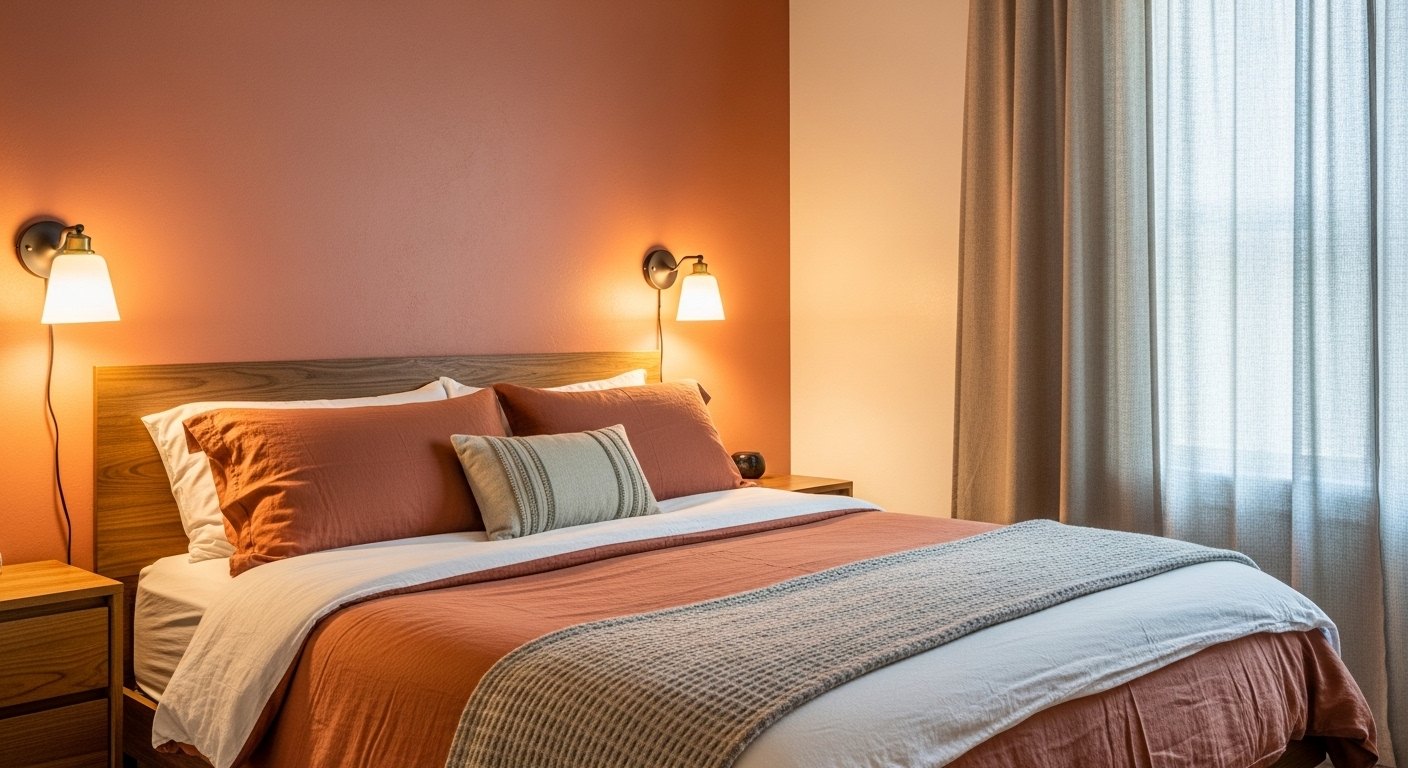
Headboard height matters for photos. We aim for something that reaches 30-36 inches above the mattress, either a proper headboard or a pair of framed prints mounted at that height. On every unit where we've done this, the bedroom photo gets more saves. Nothing elaborate, just something that makes the bed look anchored in the frame.
Bedding: Four Sets, White, No Exceptions
Guests touch the bedding for eight hours of every night and they review it constantly. We buy white, hotel-style, across every unit. White allows bleach, looks spotless in photos, and signals a hotel-quality stay rather than a home share. We buy four sets per bed: two on active rotation, one in the wash, one spare for same-day turnovers when laundry isn't dry in time.
Our linen spec: 200-300 thread count percale. Not sateen, sateen shows every wrinkle and crease in photos and after two hours of sleep. We've tested three brands across the portfolio and the ones that hold up best through 60+ wash cycles are mid-tier percale sets around $55, $70 per queen set, bought in packs. Buy four sets per bed, not one.
Pillows: four per queen bed, two firm and two medium-soft. Guests who sleep on their side and guests who sleep on their back need different support. Four pillows covers everyone. Pillow protectors go under every pillowcase and get swapped every two to three months or immediately when stained. A 500-600 fill-power equivalent down-alternative duvet, one per bed plus one spare per unit. These dry faster than real down in a standard dryer, which matters enormously on a same-day turnover.
Seating That Photographs and Survives 200 Guests
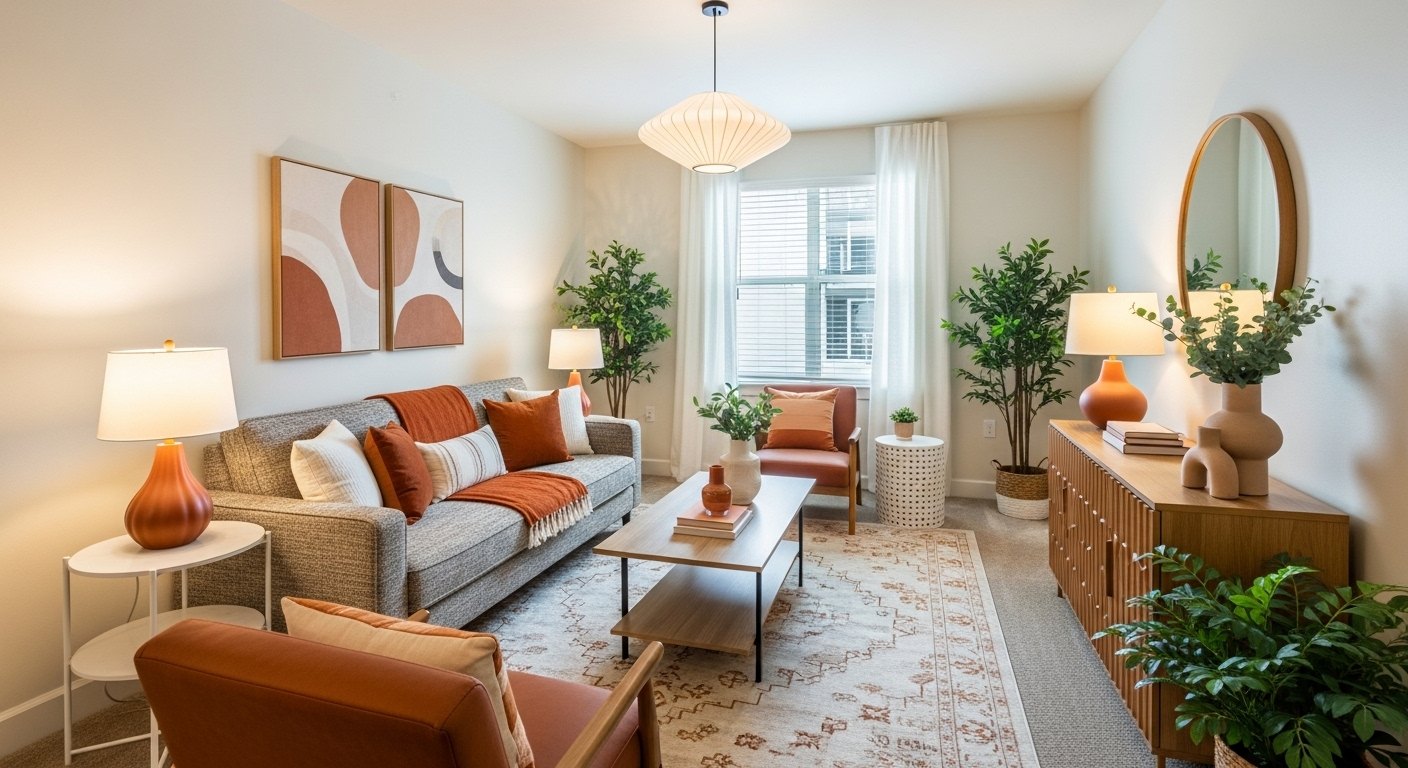
The sofa needs to do three things: look good in a listing photo, seat at least your listed guest count comfortably, and survive heavy use without staining or pilling. Performance fabric has been the single biggest upgrade we've made across the portfolio. Our first four units had regular upholstered sofas. By unit four, every one had staining issues within six months. Units five through twelve all have performance fabric, the kind marketed as stain-resistant and machine-washable. Not one has needed reupholstering in 18 months.
We like warm mid-tone neutrals. Not white (photographs perfectly but requires constant spot-treating), not dark charcoal (shows pet hair when guests sneak in animals). A warm greige or dusty olive in performance fabric has been our most durable combination and photographs well in every light.
For a one-bedroom hosting two guests, a sofa that seats three comfortably. For a two-bedroom hosting four, a sectional or a sofa plus two accent chairs. Scale matters. We've done the return trip on two sofas that looked fine in product photos and were clearly too large once in the space. Now we tape out the footprint on the floor before we order anything.
Coffee table and side table per seating area. Round coffee tables are friendlier in tight spaces. Light-toned or glass tops photograph better than heavy dark wood in a small room. And check that the surface height actually works with the sofa depth, a coffee table guests have to lean off the sofa to reach gets mentioned in reviews.
Lighting Is Infrastructure, Not Decor
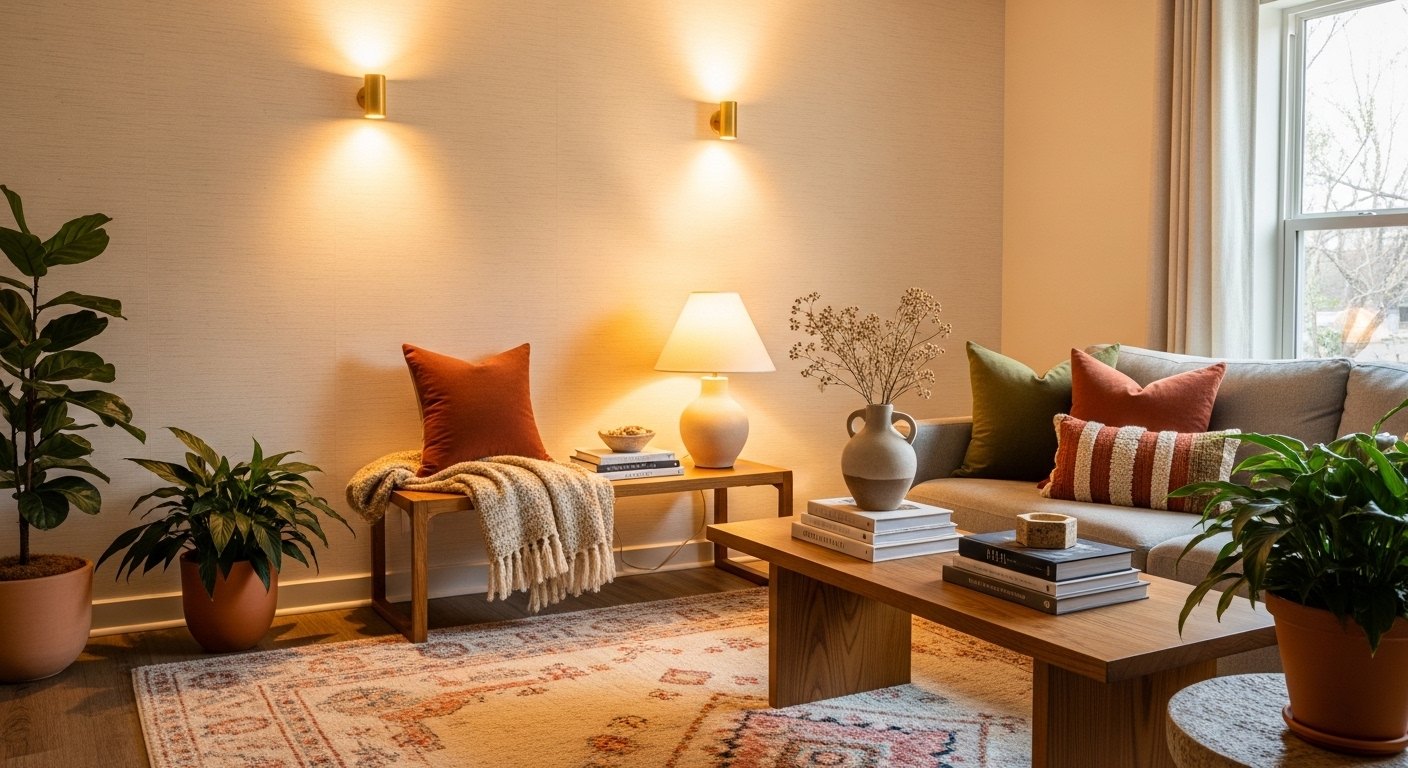
Warm, layered lighting is the highest-return change in any unit. It's what makes a listing photo look inviting rather than clinical and what makes a stay feel boutique rather than furnished-box. We treat lighting as infrastructure: installed at the same time as the furniture, not added as an afterthought after photography.
Every zone gets a dedicated light source. Dining table: a pendant light hung 30-36 inches above the surface. Living area: a floor lamp or table lamp in addition to any ceiling fixture. Bedside: plug-in wall sconces flanking the headboard at reading height, on a dimmer. Entry or hallway: a table lamp or wall light so guests walk into warmth, not a dark corridor.
We never rely on the ceiling light alone. The installed overhead almost always throws flat, harsh light that makes a unit look like an office rental. We leave it in place because guests expect it, but all our listing photos are taken with the ceiling light off and the layered lamps and sconces on. Every bulb in a unit is 2700K, warm enough to glow in photos without being orange. High-CRI (90+) where possible so colors read true in both natural and artificial light.
On a standard one-bedroom: 1 pendant over the dining area, 2 plug-in bedside sconces, 1 floor lamp in the living zone, 1 table lamp on a console or credenza. That's five to six light sources for $300, $450 total. The return on that investment in listing photo quality and guest reviews is consistently the best ROI of any single category we spend in.
The Kitchen Checklist That Stops Bad Reviews
Most bad kitchen reviews are about what's missing, not what's there. A full-size pot for pasta. A frying pan that's actually non-stick, not a pan that was non-stick two years ago. A sharp chef's knife. A real can opener. Enough plates, bowls, glasses, and mugs for your listed guest count plus two extras. A colander. A spatula that isn't melted at the edges. These things cost almost nothing individually. Their absence costs reviews.
Our kitchen checklist for a two-guest unit: 1 large stockpot with lid, 1 medium saucepan, 1 non-stick frying pan (replaced every 8-12 months), 1 baking sheet, 1 cutting board, 1 chef's knife plus bread knife, plates and bowls and glasses and mugs for four, coffee maker (we use a simple drip machine and a manual pour-over for guests who want either), can opener, colander, wooden spoon, spatula, whisk, box grater, kitchen scissors. We build this kit into a labeled box ahead of time. Kitchen setup is under 30 minutes once the box is prepped.
Don't overdo it. A two-guest unit doesn't need 12 plates and a stand mixer. Match the kitchen stock to the guest count and your listing description. Excessive kitchen equipment fills drawers, makes turnovers slower, and doesn't improve reviews.
Bathroom First Impressions
The bathroom is where guests form their first impression of a unit's cleanliness and where a bad experience gets written up most directly. We keep bathrooms spare, spotless, and well-supplied.
Towels: one bath towel, one hand towel, and one washcloth per guest, plus one extra set of each. White, same brand across the whole unit. Bleach-washed between stays, replaced when they pill or yellow. We buy in packs of 12 and keep a reserve, turnovers are too fast to order replacements mid-stay.
The essentials list: shampoo and conditioner (individual bottles or wall dispensers), body wash, hand soap, toilet paper stocked for the full stay plus two spare rolls, a working hair dryer, a clear shower caddy, and a small hook strip or shelf for guest products. That hook strip, an $8 item from any hardware store, has been mentioned positively in reviews on four of our units. Guests bring products. They need somewhere to put them. Don't make them live on the edge of the sink.
Storage and the Details Guests Actually Mention
Storage is invisible until it's missing, and then it gets reviews. Every unit we set up includes a full-length mirror (guests check their outfit before they leave; they notice when it isn't there), a luggage rack (guests don't put a suitcase on a clean bedspread if there's somewhere else to put it), a closet or clothes rod with 30 or more matching velvet hangers, bedside tables with a surface large enough for a phone and a water glass, and a surface near the entry for keys and bags.
Most of these items are $20, $60 each. The luggage rack is $35. The mirror is $40 on sale. The impact on how a unit feels versus how it photographs is significant. Units without these basics feel transactional; units with them feel cared for. There's a meaningful difference in the review language.
We also leave a framed local guide in every unit: our three favorite restaurants in each price range, the nearest grocery store and pharmacy, parking notes, and how to reach us. Guests read these. Three units have received reviews specifically mentioning the local tips by name. It takes 20 minutes to make and it signals to guests that someone thought about their trip before they arrived.
How much does it cost to furnish an Airbnb?
For a one-bedroom, about $3,000 if you shop carefully and mix in secondhand, $5,000 to $6,000 if you buy everything new in one week, and $9,000 or more for a two-bedroom done to the standard we use on the units we own. Those are our real numbers across seven Austin setups, not a formula. Three things move the total more than anything else: the mattress (never under $400), the sofa (performance fabric or you'll replace it inside two years), and whether you have the patience to wait for Marketplace listings for the dining table and side pieces. The full line-by-line breakdown is below, and the arbitrage math in our Austin arbitrage post shows what that furniture spend does to payback on a leased unit.
What We Spend and What We Skip
Current average for a furnished one-bedroom in Austin: $2,800, $3,400. Rough breakdown: mattress $400, bed frame $200, four sets of bedding $250, performance-fabric sofa $600, lighting $350, kitchen kit $150, towels and bath $180, rug $150, accent chairs or occasional side tables $200, small decor and accessories $100, and everything else, hangers, luggage rack, mirror, hooks, local guide frame, another $150.
What we skip: anything purely decorative that doesn't serve a photo or a function. Throw pillows beyond two or three (more get removed and lost). Candles anywhere guests might leave them unattended. Fragile decorative objects that break during stays and generate refund requests. Books unless they're interesting and you don't mind if they disappear. Plants that need care between stays unless a cleaner can water them reliably.
Over-decorated units are harder to clean, break more things between stays, and don't photograph better than a spare, warmly lit, well-furnished space. The goal is a unit that looks designed and welcoming in photos, functions perfectly for guests, and requires minimal management between stays. Less is usually more.
The Walk-Through Before You Launch
Before we photograph and list any unit, we do a full guest walk-through. We walk in the front door as a first-time guest, go through every room, open every drawer and cabinet, run the shower, flush the toilet, test every light switch, sit on the sofa, lie on the bed. We're looking for three categories of problem: missing things (the can opener, the extra toilet paper, the phone charger), broken things (the toilet seat that rocks, the window blind that jams), and photo problems (the lamp cord that's visible, the chair that's in the wrong position for the camera angle).
We photograph every unit ourselves with a phone before the professional shoot, in the exact lighting we'll use for the listing photos. This reveals problems that only show up in a photo frame: the dark corner the floor lamp doesn't reach, the cluttered counter that needs clearing, the wall art that's hung two inches too high. Fix everything on your own walk-through before any professional photographer sets foot in the unit. It costs nothing and saves the reshoot.
Shop this post: short-term rental pendant lighting and plug-in wall sconces for the bedside