We've installed plug-in wall sconces in every one of our 12 Austin short-term rentals. Forty-seven sconces in total, counting the doubles in every bedroom and the occasional living-room pair. We've had sconces that lasted 18 months and 400+ guest rotations without a single complaint. We've had ones that flickered within six weeks, ones where the cord cover pulled away from the wall, and one particularly bad batch where the socket connection was so loose that guests kept mentioning it in reviews. Here's the full picture: what worked, what didn't, what we do now, and why we still think plug-in sconces are the single highest-return purchase in short-term rental lighting.
Why We Put Plug-In Sconces in Every Unit
The first unit we did, unit one, had the default overhead light in the bedroom — a round flush-mount ceiling fixture that threw flat, cold light over everything. The room photographed like a DMV waiting area. We couldn't rewire; it was a leased apartment. So we mounted a pair of plug-in sconces flanking the bed, switched the ceiling fixture to a warm-white LED, and shot the bedroom again. Same furniture, same room. The difference was significant enough that our photographer asked what we'd renovated.
That was the moment we understood what lighting actually does. It doesn't decorate a room — it determines how a room feels at an emotional level. Warm, eye-level light from sconces beside the bed creates an entirely different ambiance than a ceiling fixture six feet above the mattress, even in an identical room. Every unit after that got bedside sconces as a standard installation item, not an optional upgrade.
From a practical standpoint: plug-in sconces save the bedside table lamp. In most short-term rental bedrooms there isn't enough surface space for two bedside lamps plus a phone, a glass of water, and a book. Mounting the light on the wall frees the table completely. Guests consistently mention generous bedside surfaces in positive reviews — and consistently complain about cluttered, insufficient ones.
The Bedside Setup That Gets Mentioned in Reviews
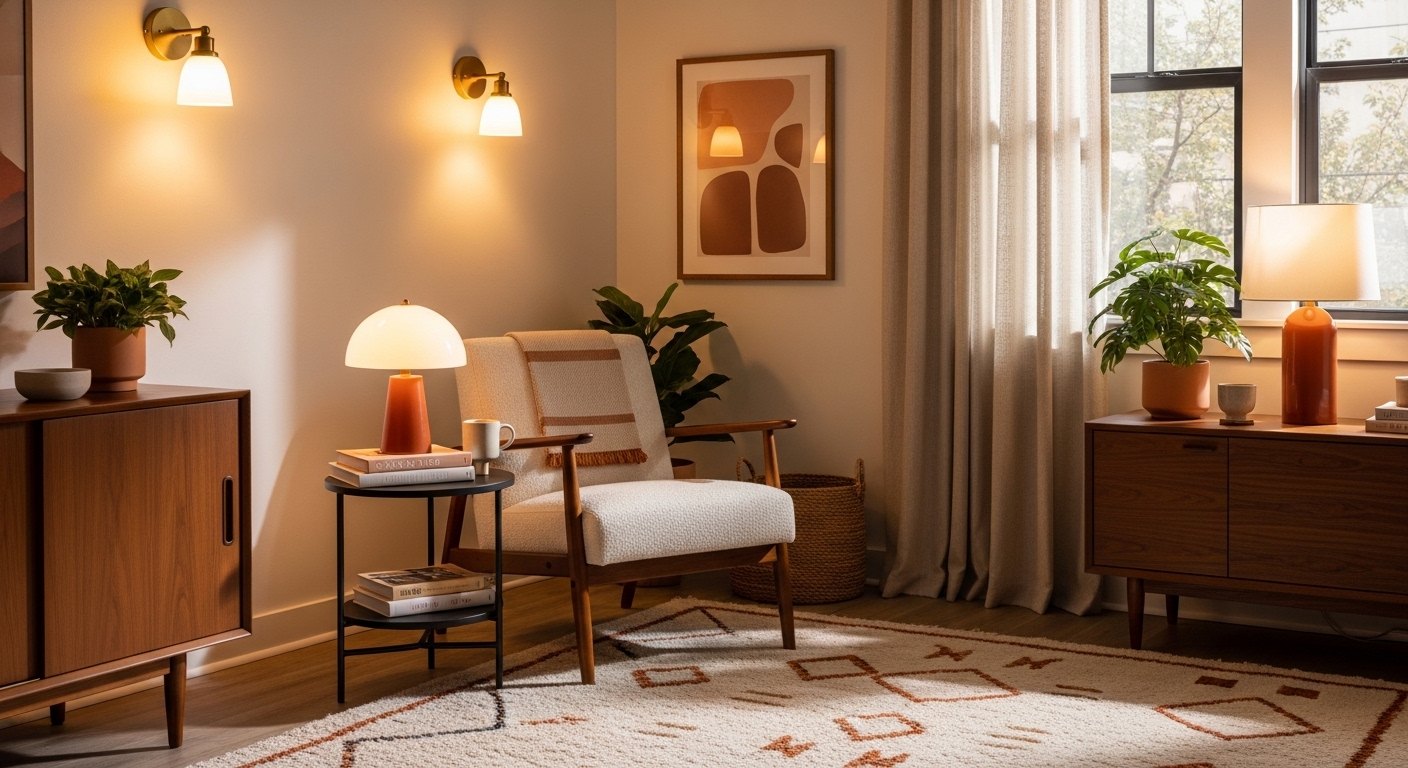
Our current standard for every bedroom: two plug-in sconces, one per side of the bed, mounted 55–60 inches from the floor to the center of the fixture. That height puts the light at reading level when a guest is sitting up in bed, which is exactly where you want it. Too low and the light shines in eyes; too high and it's no better than the ceiling fixture.
Both sconces go on a single switched outlet or a smart plug so guests can turn them both off without getting out of bed. If neither of those is feasible, we use sconces with a pull cord or touch-switch built in. Guests will not get up to walk to a wall switch to turn off a bedside light. They will unplug it, and when they do that, the cord cover comes with it. Give them a way to switch it from the bed.
Mounting: we use a standard wall anchor appropriate for the wall type, usually a toggle bolt in drywall. Two screws per sconce, level, marked with a pencil before drilling. We've tried the adhesive-only mounting brackets that some budget sconces ship with. Every one eventually pulled away from the wall, usually during a turnover when a cleaner caught the cord. Screw mounting only.
The Cord Cover Trick That Makes Them Look Built-In
The thing that separates a plug-in sconce that looks amateur from one that looks intentional is how the cord is run. This is not optional — a cord dangling freely down the wall reads as unfinished and cheap in listing photos and in person.
Our process: D-line paintable cord covers, cut to length, run straight vertically from the bottom of the sconce to the baseboard, then horizontally along the baseboard to the outlet. Never diagonally. A diagonal run draws the eye to the cord. A straight vertical path disappears once the cover is painted to match the wall.
Painting the cover is the step most people skip and the reason their sconces still look like plug-in lights. We paint the cover with the same wall paint, two thin coats with a small foam roller. Once painted, the cover virtually disappears against the wall. When we've shown units to guests in person, not one has identified the sconces as plug-in rather than hardwired.
The outlet itself: if there's a piece of furniture to tuck it behind (a bedside table, a dresser, the headboard if it's thick enough), the plug disappears completely. If not, a low-profile outlet cover and a careful tuck of the plug against the baseboard are enough. The goal is for the eye to have nowhere to land. If it lands on the cord, the illusion breaks.
What We Installed and What Held Up
Across 12 units and roughly 47 sconces, here's what we've learned about durability:
The sconces that failed within the first three to six months all shared one characteristic: loose socket connections. You'd screw in the bulb, it would be fine for two weeks, and then the vibration from guest foot traffic or simply the repeated heating and cooling of the socket would work it slightly loose and the light would start flickering. Guests reported it as "the lamp keeps going out" in two units and we received one one-star mention of it. The fix in both cases was replacing the sconce, not the bulb. Budget fixtures with thin socket housings are simply not built for the continuous-use cycle of a short-term rental.
The sconces that have held up across every unit are mid-tier fixtures from dedicated lighting brands — not furniture stores, not marketplace generics. They have thicker socket housings, sturdy cord exits where the wire leaves the fixture body, and mounting brackets that don't flex when the cord is tensioned. We pay between $45 and $90 per sconce. On a two-bedroom unit that's four sconces, so $180–$360. The ones that failed cost $22–$35 each and were replaced within six months, costing more in total than buying the right ones the first time.
Where Rechargeable Sconces Fill the Gaps
Not every wall in a rental has an outlet within reasonable cord distance. Interior bedroom walls, the wall opposite the headboard where you might want accent lighting, alcoves, and hallways are all spots where a cord cover would have to travel an impractical length to reach power. For those spots, rechargeable wall sconces are the right answer.
We have rechargeable sconces in four of our current units. Two of those are on interior bedroom walls flanking a built-in wardrobe, where the nearest outlet was on the opposite wall. Two are in entryways where there simply wasn't outlet placement that made sense for a sconce. In all four cases, guests haven't noticed or commented on the charging requirement.
Our protocol: rechargeable sconces are charged at every turnover, regardless of whether they look low. A turnover happens every few days to a week depending on bookings, so the sconces are always topped off. We leave a brief note in the house manual: "The wall lights in the entry are cordless and wireless — they have a built-in battery that we keep charged." Three guests have commented on them positively. Zero have complained.
The one limitation: most rechargeable sconces max out at two to three hours of full-brightness operation before dimming. For ambient, low-level lighting this isn't an issue. For guests who want to sit and read for four hours, they're not ideal. In bedrooms where guests will use them for reading, stick with plug-in.
Swag Pendants: The Same Logic, Applied Overhead
What a plug-in sconce does for a wall, a swag pendant does for the ceiling. Where you want a hung fixture over a dining area or a seating zone but there's no ceiling box (or the box is in the wrong position), a swag pendant hangs from a simple ceiling hook rated for the fixture's weight and plugs into a wall outlet, with the cord draped across to the wall.
We've installed swag pendants in four units over dining tables that had no ceiling box at all. The cord runs from the hook to the wall, then down inside a cord cover to the outlet, same treatment as the sconces. In two of those units we've received comments in reviews on the pendant specifically — "loved the light over the table," "the kitchen lighting was so nice." The fixture in both cases was a mid-priced glass pendant, nothing extravagant.
The main swag consideration is cord length and drop height. The pendant should hang 30–36 inches above the table surface. Add the cord run from the hook to the wall, plus whatever drop from ceiling to hook, and you'll need more cord than you'd think. Order 10 feet of extra cord minimum and tuck the excess at the wall junction where the cord transitions from horizontal to vertical.
The Bulb Is Half the Battle
None of the above matters if you put in the wrong bulb. Every sconce, every pendant, every lamp in every unit gets a 2700K warm-white LED bulb, high-CRI where the fixture allows it. Not 3000K — noticeably cooler and it ages a space. Not 4000K — that's office light, the thing guests are trying to escape from. 2700K is warm enough to feel cozy in photos and in stays without going orange.
Wattage: match the fixture's rated wattage, but in practice 5–8W LED equivalents (40–60W incandescent equivalent) are enough for a bedside sconce. Brighter isn't better in a rental bedroom. You want the kind of warm, low-level glow that makes guests feel like they're in a nice hotel room, not a well-lit operating theater.
On dimmability: if you've set up your sconces on a smart plug with scheduling or connected them to a dimmer switch, use dimmable bulbs. Non-dimmable LEDs on a dimmer circuit flicker, buzz, or burn out early. Check the bulb packaging before you install.
What We Don't Do Anymore
No more adhesive-only mounting. Every sconce with a dedicated mount goes into the wall with screws. The time it takes to patch two small holes at the end of a lease is less than the time it takes to deal with a guest whose sconce fell off the wall.
No more cheap sockets. The $22 fixture looks fine in the product photo and fails in the rental. Buy mid-tier, buy once.
No more free-hanging cords. Even on a unit where we were only planning to stay for six months, we ran the cord cover and painted it. The photos are better, the stay is better, and if we exit the unit we patch the small nail holes and the cover comes down in ten minutes.
And no more ceiling overheads as the primary light source in bedrooms. Every bedroom now has bedside sconces as the guest's primary light choice, and the overhead is there as a backup for cleaning and move-in. In the listing photos, the overhead is off. In the guest experience, it's rarely touched. The sconces do the work.
Shop this post: plug-in wall sconces and rechargeable wall sconces for interior walls